

The original guilds weren't just groups.
They were systems of craft. People sharing techniques, refining tools, raising the standard of the work itself. Guild brings that model into software.
Guilds used to be local. Now they're everywhere.
If anything goes wrong with Kubernetes clusters, we need to be in an age where agents help to scour through logs and troubleshoot, not us. Follow along in this hands-on with a local kind cluster and we'll show how easily you can get agentic troubleshooting going with Guild. Most importantly, you'll see how Guild's agents are properly credentialed and cannot access anything that you haven't approved.

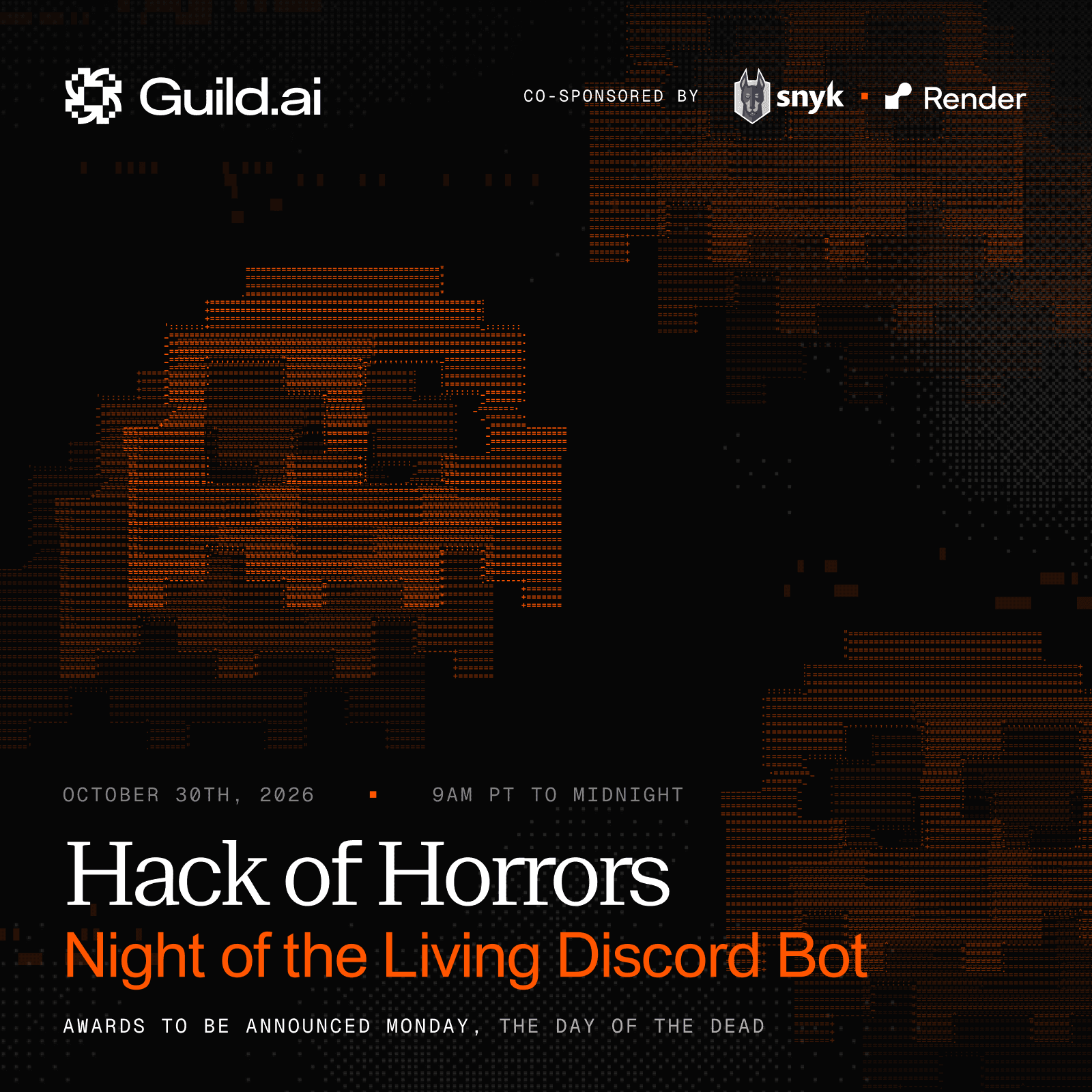
Hack of Horrors

Find a Forge near you.
The Guild meets in cities around the world. IRL and virtually.
Hack of Horrors

Start Building in Minutes
Deploy your first agent, scope permissions, connect your stack. Real code, real governance.
Get running in under 5 minutes

# Install the Guild CLI
$ npm install -g @guild/cli

# Initialize your workspace
$ guild init my-workspace

# Deploy a code review agent
$ guild deploy agent/code-review \
    --scope github:my-org \
    --budget $50/day

# Agent deployed. Monitoring active.
✓ code-review-agent is live
Learn from the Guild
The best work doesn't stay hidden. Guild is built on shared knowledge: patterns that hold up, tools that actually work, ideas tested by your peers. You don't just consume it—you add to it.

Agent and Integration Hub
Browse and deploy pre-built agents for code review, security scanning, incident response, and more. Start with a template, customize for your stack.

Guild Docs
Technical documentation, API references, quickstart guides, and everything you need to build, deploy, and govern agents on Guild.

Guild YouTube
Product walkthroughs, quickstarts, and conversations with engineering leaders about what’s actually working with AI agents.
Build Together
The work gets better when people do. Guild exists to make that happen.

Slack
Real-time conversations with the Guild team and community.

Discord
Share agents, discuss patterns, and connect with the community.

Be part of the conversations shaping the future of AI. Connect with engineers sharing real-world lessons and experiences.
From the Discord community
Real conversations from members building on Guild.
Is task.env.create() / task.env.exec() available in the current SDK? We need to run a Node.js shell command from inside an agent's run() function. We're hitting the Babel state machine limitation with native https module calls.
Amazing workshop and use cases. looking forward to the recordings.
Is task.env.create() / task.env.exec() available in the current SDK? We need to run a Node.js shell command from inside an agent's run() function. We're hitting the Babel state machine limitation with native https module calls.
Amazing workshop and use cases. looking forward to the recordings.
Claim your Guild ID
Every member gets their shield.


First look at new features, agents, and integrations before they ship.
Private channel with the engineering team. Your feedback shapes the product.
An agent control plane is the infrastructure layer that governs AI agents in production. Guild's is built on four primitives: workspaces that contain agents and their policies, organization-level credentials injected at runtime, sessions that log every run, and triggers that automate execution. Without one, every agent holds its own keys, runs without an audit trail, and spends without attribution. A control plane replaces that sprawl with one place to see, control, and account for every agent.
Guild scopes access structurally rather than by role labels. Credentials are connected once at the organization level and injected at execution time, so agents never hold raw keys. Workspace-level policies decide which teams and agents can use which integrations: a support workspace cannot reach engineering's GitHub credentials. Model policies follow a hierarchy from account to workspace to agent, and disconnecting a credential instantly revokes access for every agent that used it.
Yes. Workspaces hold multiple agents, triggers automate when each one runs (webhooks, schedules, or API calls), and agents can spawn sub-tasks, which are captured in the parent session. That last part is the difference from ungoverned multi-agent setups: when work passes between agents, the whole chain lands in one trace, so you can see which agent did what, in what order, with what result.
Guild enforces hard limits, not advisory ones. A daily token limit caps LLM consumption: once the limit is exceeded, further LLM requests are rejected for the rest of the day. Model policies control which models an API key can call, applied hierarchically from account to workspace to agent. And because every session records the model and token count of each LLM call, spend is attributable per agent before it ever becomes an invoice surprise.
Every agent run produces a session: a read-only log of each LLM call, tool invocation, sub-task spawn, error, and lifecycle transition, with timestamps and payloads. Logs cannot be edited after the fact. That gives security and compliance teams what audits of automated systems actually require: a complete record attributing every action to a specific agent, reviewable long after the run.
The fastest path is installing a pre-built agent from the Agent Hub, where teams publish validated agents like ticket triage and PR review, ready to run in your workspace. Building your own is three CLI steps: scaffold with guild agent init, test locally with guild agent test --ephemeral, then publish with guild agent save --publish. Either path gets a first governed agent running the same day you start, typically within minutes.